
Professional Custom Sock & Bag Manufacturer
- All
- Product Name
- Product Keyword
- Product Model
- Product Summary
- Product Description
- Multi Field Search


Views: 999 Author: Cathy Publish Time: 2026-10-23 Origin: Site


Why does your second sock order often cost less than your first? In custom sock manufacturing, repeat orders can reduce unit costs by spreading development expenses across more units, reusing approved samples and production specifications, reducing setup time, and improving material planning. However, the savings depend on order quantity, yarn selection, design complexity, production capacity and changes made between orders.
For private-label brands, e-commerce sellers, wholesalers and promotional merchandise buyers, understanding these cost drivers makes it easier to negotiate competitive prices without sacrificing quality.
This guide explains where first-order costs come from, why repeat production can be more economical, how to estimate potential savings, and what buyers should confirm before placing their next custom sock order.
In this guide
Why the first sock order costs more
The difference between setup costs and unit costs
What changes when you place a repeat order
How order quantity affects sock pricing
A practical first-order vs. second-order cost comparison
Which costs can be reused—and which cannot
How design changes affect repeat-order pricing
Yarn purchasing and production efficiency
How to reduce costs without compromising quality
A repeat-order checklist for buyers
Frequently asked questions
The first custom sock order often involves more than knitting the required quantity. Before bulk production begins, the factory may need to confirm the design, prepare knitting programs, source yarn, develop samples, test fit and construction, approve colors, and establish the production and inspection requirements.
These activities require time and resources. Some are one-time development tasks; others are recurring costs that must be paid for every production run.
For example, a brand ordering custom athletic socks for the first time may need to approve the following:
Sock length, size range and knitting structure
Yarn composition, color and performance requirements
Logo placement, artwork and knitting details
Cushioning, terry construction and reinforcement zones
Sample fit, elasticity and overall appearance
Packaging, labeling and carton requirements
Once these details are approved and documented, a repeat order can often move into production with fewer development steps.
The important distinction is that a repeat order does not eliminate manufacturing costs. It can reduce the additional work required to manufacture the same product again.
A custom sock quotation generally combines several types of costs. Separating them helps buyers understand which expenses may decrease on subsequent orders.
| Cost category | First order | Repeat order |
|---|---|---|
| Design and artwork preparation | May require initial setup | Often reusable if unchanged |
| Knitting program development | May require programming and testing | Existing program may be reused |
| Sample development | Usually needed for initial approval | May be reduced or skipped if specifications remain unchanged |
| Yarn and other materials | Required | Required again |
| Knitting and finishing | Required | Required again |
| Quality inspection | Required | Required again |
| Packaging and labeling | Required | Required; artwork may be reusable |
| Shipping and duties | Depend on shipment terms | Depend on shipment terms |
The largest potential savings usually come from avoiding unnecessary development work and improving production efficiency—not from eliminating the cost of yarn, labor or finishing.
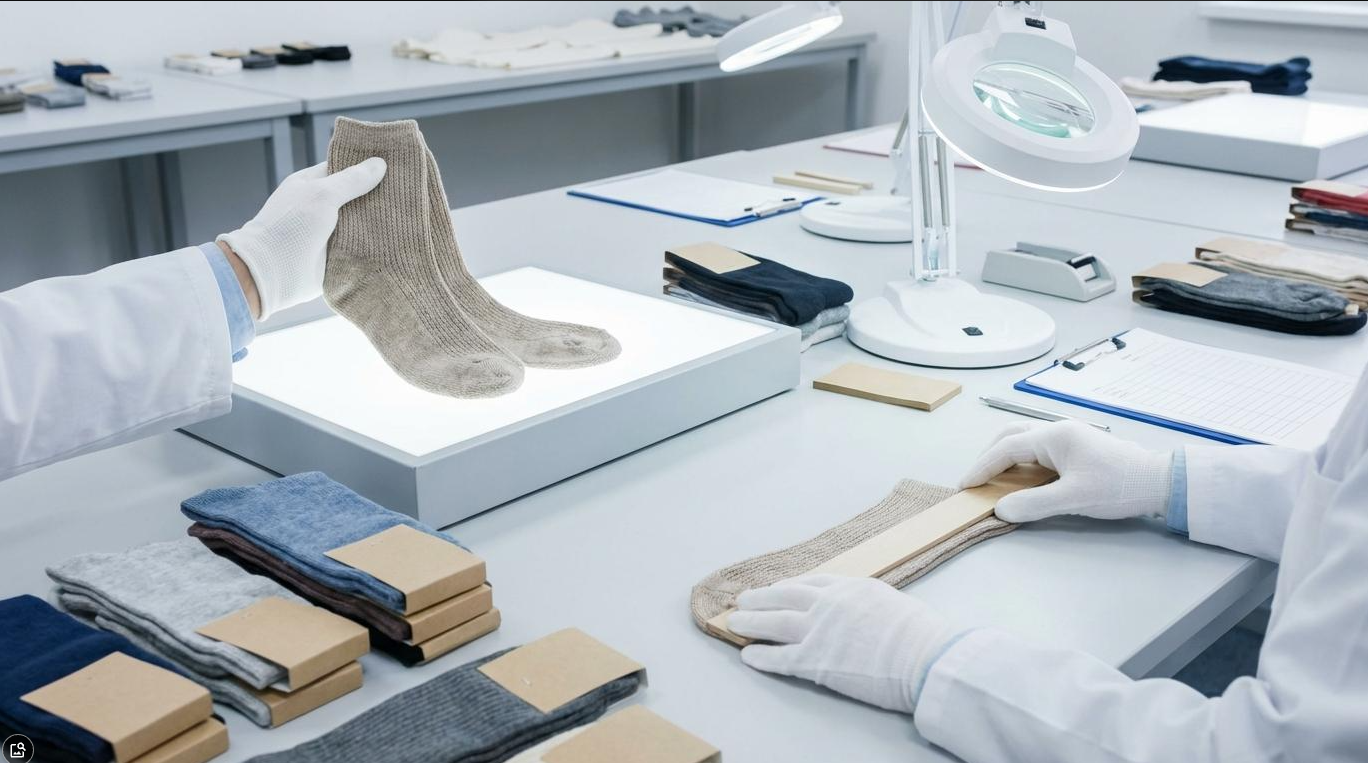
For a new custom sock project, the factory may need to review the artwork, confirm the knitting method, determine logo placement, and test whether the desired design can be produced consistently.
After approval, the final specifications can be retained for future orders.
This reduces repeated communication and helps prevent avoidable mistakes. If your next order uses the same sock design, yarn composition, colors, size range and packaging, the factory may be able to proceed directly to production planning.
Custom knitted socks may require machine programming and technical settings based on the design and construction.
When the same approved design is reordered, existing production files and specifications may be reused, subject to machine compatibility and factory procedures.
This can reduce preparation time and the need for repeated development trials.
The first order may involve several rounds of sample revisions. The buyer and manufacturer must confirm that the product matches the approved requirements.
For an unchanged repeat order, the previous approved sample, specification sheet and quality standards can serve as the production reference.
A new sample may still be appropriate if materials, machinery, construction or quality requirements have changed. Skipping sampling should be a documented decision, not an assumption.
Once a factory understands the product, it can plan machine time, yarn requirements, finishing capacity and packaging more accurately.
Repeat orders can also make it easier to combine compatible production tasks, reduce unnecessary changeovers and purchase materials more efficiently.
These benefits are not automatic. They depend on order volume, scheduling, factory capacity and whether the repeat order matches the original specifications.
There is no universal percentage. The actual savings depend on the first quotation, development charges, order quantity, yarn prices, design complexity and changes to the specification.
Consider a simplified example in which the first order includes a separate development cost.
Illustrative assumptions
Order quantity: 5,000 pairs
First-order development and setup cost: $500
Recurring production cost: $2.00 per pair
Second order: same design and specifications
Repeat-order development cost: $0, assuming no additional development is required
| Cost item | First order | Second order |
|---|---|---|
| Development and setup | $500 | $0 |
| Production: 5,000 pairs × $2.00 | $10,000 | $10,000 |
| Total order cost | $10,500 | $10,000 |
| Effective cost per pair | $2.10 | $2.00 |
In this example, the effective cost decreases by $0.10 per pair, or approximately 4.8%.
This is an illustration of cost allocation, not a guaranteed factory discount. In real quotations, setup and development expenses may already be included in the unit price, so the same savings should not be counted twice.
The key takeaway: The more units over which a one-time cost is spread, the smaller its contribution to the cost per pair.
To understand repeat-order pricing, separate fixed costs from variable costs.
Fixed or order-specific costs are expenses that may not change directly with the number of pairs produced. Depending on the factory and project, these may include initial programming, artwork preparation, sampling or a production setup charge.
Variable costs rise with the quantity produced. These commonly include yarn, knitting time, linking or toe closing, boarding, finishing, packaging and other per-pair operations.
A simple cost model is:
Total order cost = fixed costs + (variable cost per pair × quantity)
And:
Effective cost per pair = total order cost ÷ quantity
Using the illustrative figures above:
| Production scenario | Quantity | Fixed cost | Variable cost per pair | Effective cost per pair |
|---|---|---|---|---|
| First order | 1,000 pairs | $500 | $2.00 | $2.50 |
| Repeat order | 1,000 pairs | $0 | $2.00 | $2.00 |
| Larger repeat order | 5,000 pairs | $0 | $2.00 | $2.00 |
The table isolates the effect of a hypothetical fixed charge. It does not assume that every sock factory charges the same setup fee or that the variable production cost remains constant at every volume.
At larger quantities, the variable cost per pair may also decrease if production runs more efficiently or materials are purchased at better rates.


