
Professional Custom Sock & Bag Manufacturer
- All
- Product Name
- Product Keyword
- Product Model
- Product Summary
- Product Description
- Multi Field Search


Views: 369 Author: Cathy Publish Time: 2026-10-26 Origin: Site


Conclusion first: If "color quality" is the sole criterion, sublimation printing delivers the highest performance in color gamut, gradient smoothness, and image fidelity. However, this conclusion comes with strict preconditions—the sock must have a high polyester content and a white or light-colored base. If the sock is cotton or has a dark base, digital direct-to-garment (DTG/DTF) is the more realistic high-quality color option, while screen printing only achieves acceptable color performance in simple spot-color scenarios.
This article does not discuss "which printing method is best," as that depends on order quantity, fabric composition, and wash durability requirements. This article answers only one question: given the fabric and design conditions, which printing method outputs the highest color quality?
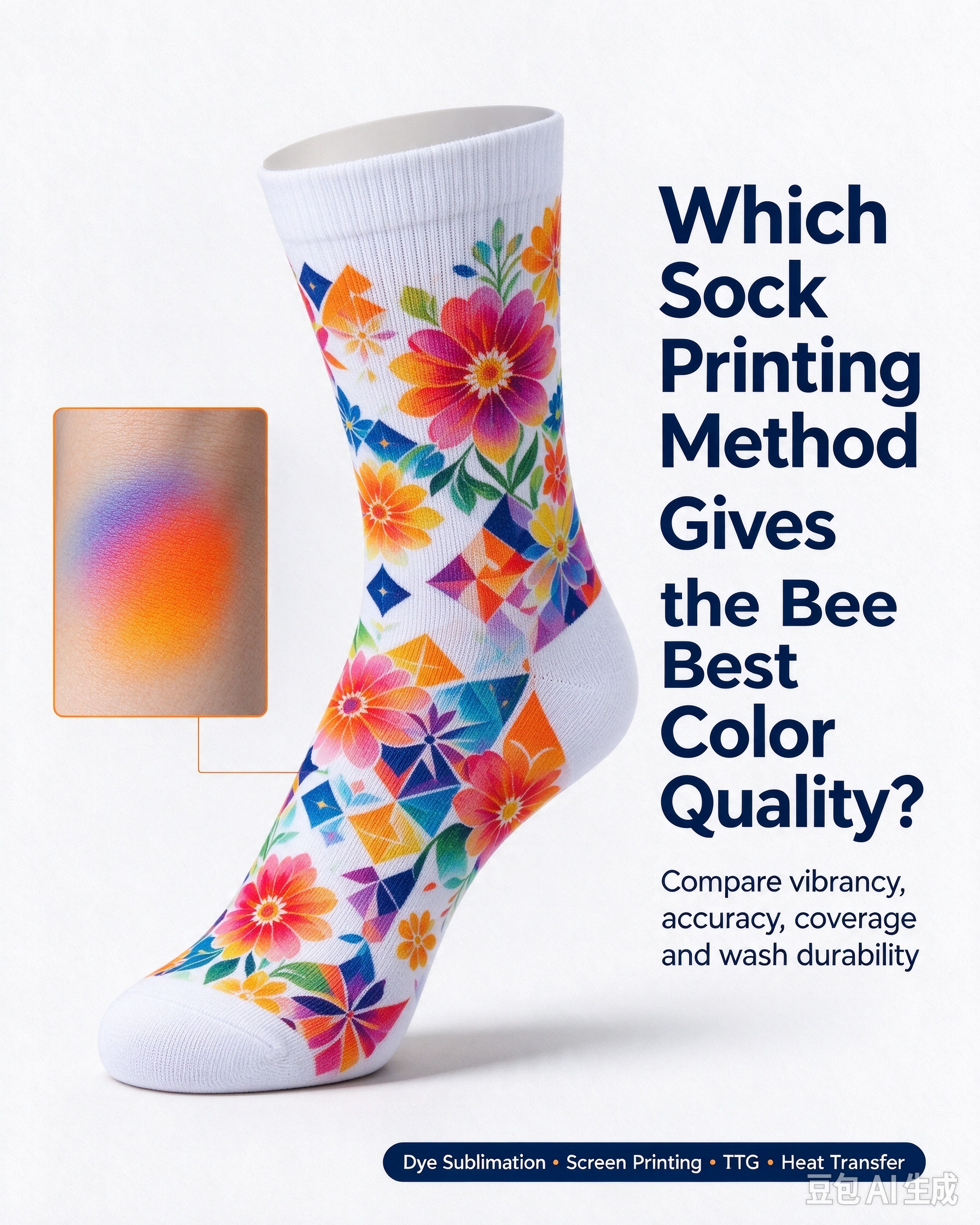
Before comparing printing methods, it is necessary to define what "color quality" means on a sock substrate. Socks are curved, highly stretchable, frequently washed textiles. Color quality cannot be judged solely by vibrancy at the proofing stage; it must also consider:
Color Gamut: How many colors can be covered, and whether gradients and photo-realistic images are supported.
Color Accuracy: The ability to control color deviation from design file to finished product.
Color Durability: Color retention rate after multiple washes.
Base Color Adaptability: Whether accurate colors can be rendered on dark socks.
Hand-feel Side Effects: Whether the color carrier (ink layer) alters the inherent touch of the sock.
The following assessment of four mainstream methods revolves around these five dimensions.
Sublimation is the only printing method that can achieve unlimited colors on socks. At approximately 200°C, ink transitions directly from solid to gas, penetrating polyester fibers and bonding with them. This means:
Gradients, watercolor effects, and photo-realistic images can be fully reproduced, with no banding in color transitions as seen in screen printing.
Ink does not remain on the fiber surface, so there is no hand-feel alteration; printed and unprinted areas feel identical.
In controlled tests, sublimation-printed socks retained approximately 95% of original color vibrancy after 50 washes.
However, the preconditions for color quality are extremely strict. Sublimation ink is transparent; dark base socks will show through and distort the target color. For example, sublimation printing on navy socks will produce dull, muddy colors that deviate from the design file, rather than vibrant original colors. Regarding fabric, polyester content typically needs to reach 65% or higher to ensure effective ink bonding. Cotton socks cannot achieve acceptable color with sublimation printing.
Color Quality Verdict: On white/light-colored high-polyester socks, color quality is the highest among all methods. On cotton or dark socks, not applicable.
Digital direct printing uses modified inkjet technology to spray textile ink directly onto the sock surface. Unlike sublimation, DTG can work on cotton and cotton blends, and through a process of printing a white ink underlayer first, it can render vibrant colors on dark socks. This solves sublimation's biggest color blind spot.
In terms of color range, DTG likewise supports full color and gradients, with color performance approaching sublimation. The problem lies in color durability. Because ink remains on the fiber surface rather than penetrating into the fiber interior, DTG prints fade more noticeably after repeated washing. Test data shows that after 30 washes, DTG socks typically retain 70%–80% of original color vibrancy, while sublimation remains above 95% at the same stage. The ink layer also imparts a slight texture to the printed area.
Color Quality Verdict: The best option for color performance on cotton or dark base socks, but color lifespan is significantly shorter than sublimation (on applicable fabrics). Suitable for design-driven scenarios with moderate wear frequency or less demanding long-term wash resistance.
Screen printing applies paste through a mesh screen onto the sock surface. In the context of color quality, its positioning is very clear: it can do a few colors well, but cannot do color itself well.
Screen printing can achieve vibrant spot colors, including metallic and fluorescent colors, which are difficult for sublimation and DTG to replicate. However, it performs poorly on the following dimensions:
Number of Colors: Each color requires a separate screen and separate printing pass; exceeding 4–5 colors becomes uneconomical, and gradients are impossible.
Color Durability: The ink layer sits on the fiber surface; after repeated washing, it is prone to cracking, peeling, and fading, especially in thick ink deposit areas.
Hand-feel: The printed area has noticeable raised and hardened texture.
Base Color Limitations: On dark socks, if water-based paste is used, the color penetrates the fiber and does not show; opaque (plastisol) ink must be used to render visible color, but the hand-feel is harder.
The upper limit of screen printing's color quality is "a clear, vibrant single or dual-color logo," not "rich color expression."
Color Quality Verdict: Only suitable for simple spot colors and small-area graphics. Comprehensively behind sublimation and DTG in color range, gradient capability, and wash color retention.
Jacquard knitting is strictly not printing, but knitting different colored yarns directly into the pattern during the knitting process. The reason it needs to be included in the comparison is that on the "color durability" dimension it is unmatched: color is part of the yarn itself, will not crack, peel, or fade, and its lifespan equals that of the sock.
However, its color quality is constrained by physical limitations: typically a maximum of 6–8 colors per sock, with no possibility of gradients or photo-realistic images, and fine text clarity limited by knitting machine gauge. Colors are "clean," but not "rich."
Color Quality Verdict: Limited color count, but highest color accuracy and durability. Suitable for scenarios with clear brand colors and designs primarily based on geometry and text.
| Sock Condition | Best Choice for Color Quality | Rationale | Trade-offs to Accept |
|---|---|---|---|
| White/light, polyester ≥65% | Sublimation | Unlimited colors, zero hand-feel, 95%+ wash color retention | Fabric restricted, dark base unusable |
| Cotton or cotton blend, light base | DTG (pigment ink) | Best color performance on cotton, full-color gradients available | Shorter color lifespan, approx. 70–80% after 30 washes |
| Cotton or cotton blend, dark base | DTG (with white ink underlayer) or DTF | White underlayer makes vibrant colors possible on dark base | White ink adds cost and slight hand-feel |
| Polyester, dark base | DTG/DTF (sublimation not viable) | Sublimation colors distort on dark base | Same as above |
| Simple 1–3 color logo, any fabric | Screen printing | Vibrant spot colors, low cost | No gradients, poor wash color, hard hand-feel |
| Fixed brand colors, pursuit of ultimate wash resistance | Jacquard knitting | Color is yarn, never fades | Max 6–8 colors, no gradie |


