
Professional Custom Sock & Bag Manufacturer
- All
- Product Name
- Product Keyword
- Product Model
- Product Summary
- Product Description
- Multi Field Search


Views: 899 Author: Cathy Publish Time: 2026-10-26 Origin: Site


Screen printing is a process in which ink passes through a prepared mesh screen onto a suitable textile surface. A separate screen is generally required for each color in the design.
For custom socks, this technique may be suitable for simple logos, bold graphics, and limited-color artwork when the sock surface and production equipment support the process.
Artwork preparation: The design is separated into individual colors.
Screen preparation: A screen is prepared for each color.
Ink application: Ink is transferred through the screen onto the compatible surface.
Color alignment: The different colors are registered to form the complete design.
Curing and inspection: The print is cured as required and checked for appearance and quality.
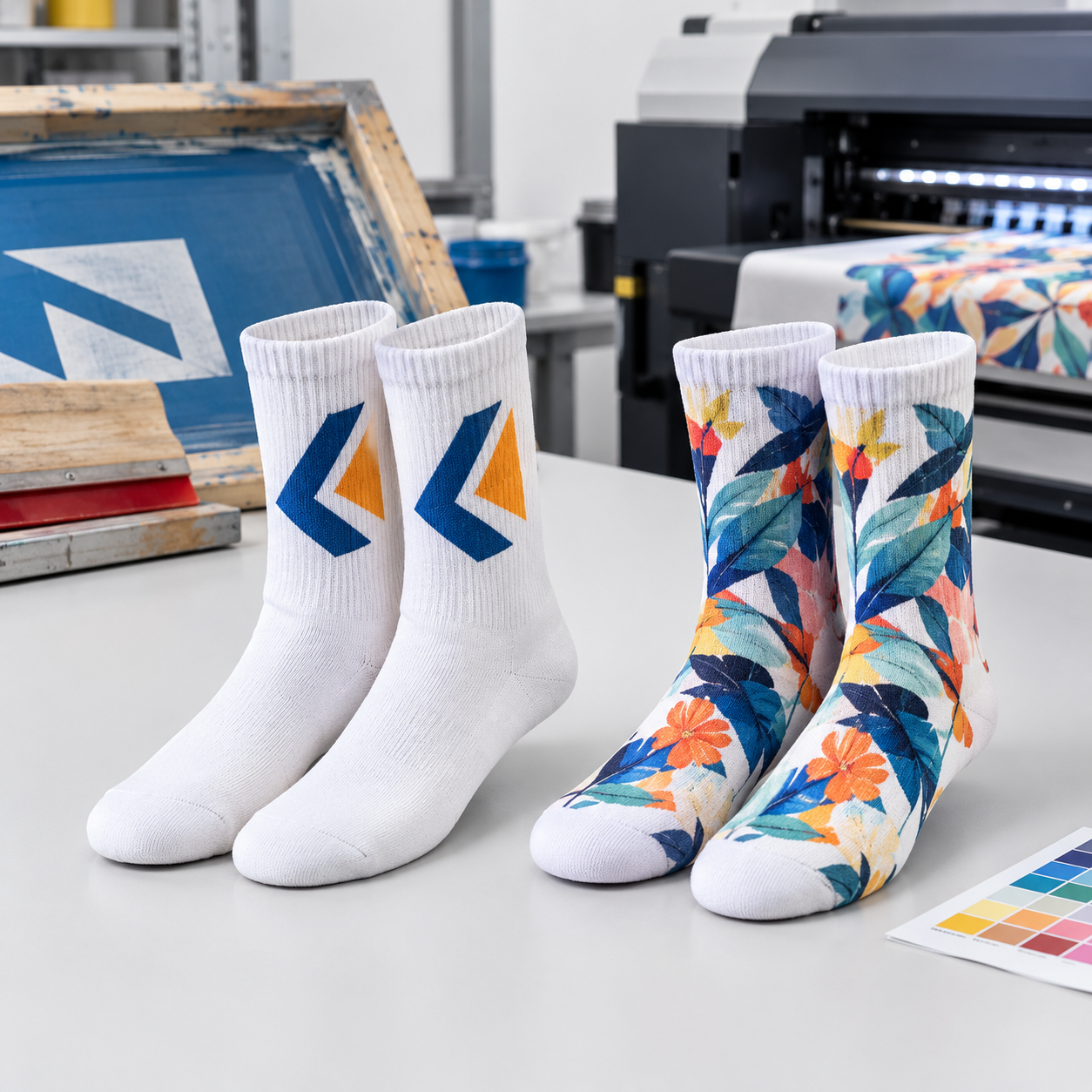
Suitable for bold graphics and solid colors.
Can be cost-effective for repeat production of the same design.
Offers good repeatability when the process is properly controlled.
Can produce clear logos on compatible surfaces.
Screen preparation increases initial setup requirements.
Multi-color designs can require more setup and alignment work.
Complex gradients and photographic artwork may be difficult or uneconomical to reproduce.
Ink coverage may affect the feel and flexibility of the fabric.
Not every knitted sock surface is suitable for direct screen printing.
Screen printing is worth considering when your artwork is relatively simple and you plan to produce repeated batches of the same design.
Digital printing uses specialized printing equipment to reproduce digital artwork on compatible textiles. Depending on the technology, it can accommodate fine details, complex patterns, gradients, and a wide range of colors without preparing a separate screen for every color.
Different digital textile processes have different material requirements. Some are performed on textile fabric before the socks are formed, while others can print on suitable finished products. The appropriate method depends on the equipment, ink system, and sock construction.
Digital design preparation: Artwork is prepared in a suitable file format.
Color management: Colors are adjusted for the printer, ink, and fabric.
Material preparation: The textile is prepared according to the printing process.
Printing: The machine reproduces the design on the compatible surface.
Fixing and finishing: Required curing, heat treatment, or other finishing is completed.
Quality inspection: The finished product is checked for color, placement, and print performance.
Suitable for detailed and multicolor artwork.
Can reproduce intricate patterns and gradients.
Makes artwork changes easier because new screens are generally unnecessary.
Can be practical for certain small-batch orders.
Supports flexible design development for fashion and promotional collections.
Equipment and ink costs can be significant.
Fabric composition and pretreatment affect the final result.
Color accuracy depends on the printing system and color management.
Some processes require additional finishing.
Durability varies by ink system, fabric, and fixation method.
For brands that prioritize detailed patterns or frequent design changes, digital printing may provide greater flexibility.
| Factor | Screen Printing | Digital Printing |
|---|---|---|
| Design style | Bold graphics and simple artwork | Detailed patterns and complex artwork |
| Color options | Strong solid colors | Broad color range, including gradients with suitable systems |
| Setup | Screens generally required | Digital file and machine setup |
| Small orders | Setup can increase unit cost | Can be more flexible for short runs |
| Large orders | May offer attractive repeat-production economics | Depends on print speed and production costs |
| Design changes | May require new screens | Often simpler to implement |
| Print feel | Depends on ink and coverage | Depends on the digital process and fabric |
| Durability | Depends on ink, curing, and material | Depends on ink, fixation, and material |
| Material compatibility | Requires a suitable printable surface | Requires compatibility with the selected digital process |
| Best application | Suitable simple designs and repeat runs | Intricate artwork and flexible design changes |
Important: These are general comparisons, not universal guarantees. Actual results depend on the equipment, ink system, textile composition, and sock construction.
The best printing method depends on what you want the finished socks to look like.
Screen printing can produce strong, clearly defined color areas when the ink and surface are compatible.
It may be appropriate for promotional socks with a simple company logo, basic geometric artwork, or a limited number of solid colors.
Digital printing is often worth evaluating for:
Detailed floral patterns
Intricate illustrations
Multicolor artwork
Gradients and complex visual effects
Designs that change frequently between collections
For example, a fashion brand creating socks with a detailed botanical pattern may prefer a suitable digital textile printing process.
Neither printing method automatically guarantees an exact match to a screen design.
Before bulk production, request a physical sample and confirm the approved colors, placement, scale, and overall appearance. For brand-critical colors, provide a reference color standard and agree on acceptable variation with your supplier.
The cost of custom printed socks depends on more than the printing method alone. Artwork complexity, order quantity, fabric composition, production speed, finishing, and quality requirements all influence the final quotation.
| Cost Factor | Screen Printing | Digital Printing |
|---|---|---|
| Initial setup | Screen preparation and color separation | File preparation and machine setup |
| Number of colors | Additional colors may increase setup work | Multiple colors can be included in one digital design |
| Small orders | Setup costs can increase unit price | May reduce certain setup costs |
| Repeat orders | Existing screens may reduce repeat setup costs | Existing artwork may simplify preparation |
| Finishing | Depends on ink and curing requirements | May require pretreatment or additional fixation |
| Overall unit cost | Often attractive for suitable repeat runs | Depends on equipment, print speed, and material |
For large repeat orders with simple artwork, screen printing may provide favorable unit economics if the production process is suitable.
For smaller runs or detailed multicolor designs, digital printing may reduce some setup costs and simplify artwork changes.
However, custom sock manufacturing also involves knitting, material selection, dyeing, finishing, inspection, and packaging. A meaningful quotation should compare the total cost per accepted pair, not just the cost of applying the design.
When requesting a quote, provide the material, sock size, artwork, quantity, print area, and packaging requirements. Ask your manufacturer to compare feasible production methods using the same specifications.
Durability matters for everyday socks, sports socks, and promotional products that may be washed and worn frequently.
Neither screen printing nor digital printing is automatically more durable in every situation. Performance depends on the ink system, fabric, curing or fixation process, and amount of stretching and abrasion during use.
1. Fabric composition
Cotton, polyester, nylon, and blended textiles have different surface characteristics and may require different printing processes.
2. Ink compatibility
The ink must be appropriate for the textile. Poor compatibility can contribute to fading, cracking, or peeling.
3. Stretch and recovery
Socks stretch during wear. A print that performs well on flat material may behave differently when the fabric is repeatedly stretched.
4. Washing and abrasion
Friction from shoes and repeated washing can affect the appearance of the finished design.
Before approving a bulk order, ask for samples produced using the actual sock material and proposed printing process. Where necessary, agree on washing, stretch, and abrasion tests with defined acceptance criteria.
For sports socks, also assess whether the printed area affects flexibility, moisture management, breathability, or wearing comfort.
Choosing a printing method should begin with your product requirements, not simply the lowest quotation.
Simple logos and limited-color graphics may suit screen printing on compatible surfaces. Detailed patterns and complex multicolor artwork may benefit from digital printing.
Identify whether the socks are made from cotton, polyester, nylon, or a blend. Ask the supplier which process works with the selected material and construction.
Discuss minimum order quantities, setup costs, production capacity, and repeat-order pricing. Compare the total production cost rather than relying on assumptions about which method is cheaper.
For sports and performance socks, evaluate stretch, breathability, moisture management, and surface feel. Large printed areas may behave differently from small logos.
Check color, placement, appearance, comfort, and durability before confirming bulk production.
| Product Type | Printing Direction to Evaluate | Main Consideration |
|---|---|---|
| Promotional socks | Screen printing for suitable simple graphics | Logo clarity and repeat production |
| Fashion socks | Digital textile printing for complex patterns | Color variety and detail |
| Sports socks | Evaluate printing and knitted-in designs | Stretch, comfort, and durability |
| Corporate branded socks | Screen printing for suitable limited-color designs | Brand consistency |
| Personalized socks | Digital printing where technically suitable | Design flexibility |
| Large repeat orders | Compare both production quotations | Unit economics and repeatability |
One important alternative is knitted-in designs, in which colored yarns form the pattern as the sock is manufactured. This may be more suitable than surface printing for many conventional custom socks, particularly where stretch, comfort, and long-term wear are important.
Ask your manufacturer to compare printing with knitted-in artwork if both options can achieve the intended design.
Mistake 1: Choosing based on price alone.
A low initial printing cost does not guarantee a lower total production cost. Consider setup, finishing, material compatibility, and quality control.
Mistake 2: Assuming every design works on every sock.
Sock shape, knitted texture, elastic areas, and fabric composition can limit the available processes. Confirm technical feasibility before finalizing the artwork.
Mistake 3: Ignoring durability.
A sample may look attractive when new but perform poorly after washing or stretching. Test the actual finished product.
Mistake 4: Skipping sample approval.
Digital artwork cannot fully represent the final color, texture, or appearance on a knitted surface. Approve a physical sample whenever possible.
Mistake 5: Confusing printing with knitting.
Some sock designs are better created using colored yarns during knitting rather than applying ink to the finished fabric. Discuss both options with your manufacturer.
Neither method is universally better. Screen printing can suit bold, limited-color graphics, while digital printing is often useful for detailed multicolor artwork. The right choice depends on the design, fabric, order quantity, and required performance.
Digital printing may be more flexible for some small orders because it can reduce screen-related setup requirements. Actual minimum order quantities and pricing depend on the supplier and production technology.
Digital printing is often worth considering for detailed artwork, gradients, and complex patterns. The available color range and final result depend on the specific technology and textile.


